There’s nothing more frustrating for us players than encountering a game-breaking bug at a critical moment, right? That’s why understanding what causes bugs in games is crucial for any game developer, publisher, or enthusiast interested in delivering a smooth and enjoyable player experience.
Whether it’s a character falling through the map, an unexpected crash, or multiplayer desynchronization, these issues can ruin immersion and damage a game’s reputation. Bugs represent more than just an annoyance – they’re often a sign of deep-rooted complexity and challenges within the development process.
These problems don’t appear out of nowhere: they result from a combination of technical intricacies, design decisions, hardware limitations, and often, the human element behind the code. Each phase of development, from ideation to post-launch updates, carries potential points of failure that can lead to glitches, crashes, or inconsistencies.
In this article, we’ll break down the core reasons behind the emergence of bugs, exploring how game systems interact in unpredictable ways, why networked environments make things even trickier, and what steps developers can take to prevent bugs before they reach the hands of the public.
Read also: Automation tools for game testing – what are they?
What causes bugs in games? The fundamentals
Game development is an intricate dance involving hundreds or even thousands of interwoven components, from gameplay logic to graphics, audio, physics, networking, and platform-specific integrations.
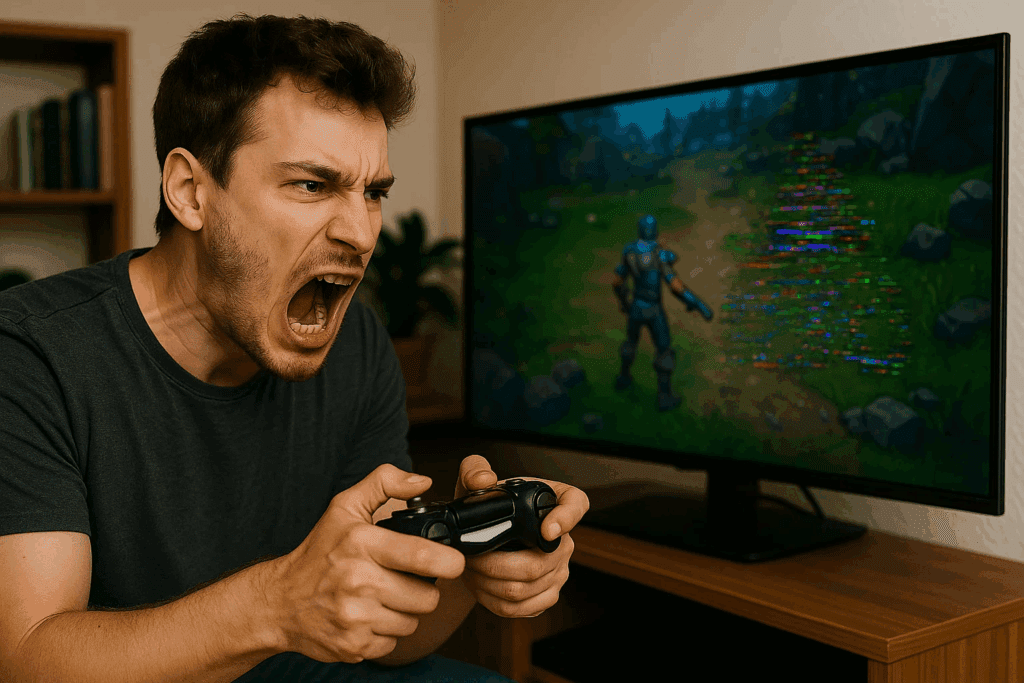
The first fundamental cause of bugs in games lies in software complexity. In software engineering, bugs arise naturally in large codebases: the more lines of code and the greater the number of interactions, the higher the probability that something behaves unexpectedly.
Another root cause is design flaws or logic errors. These often result in gameplay actions leading to unintended outcomes, such as infinite loops or off-by-one errors. These are usually defects in design or implementation that lead to unexpected behavior or crashes.
Memory corruption and leaks are another frequent culprit. Memory-related bugs cause crashes and unpredictable behavior when pointers point to invalid memory or when resources aren’t properly managed.
Concurrency and race conditions introduce further complexity when simultaneous systems, like AI, physics, and rendering, attempt to read or write shared resources without proper synchronization. These bugs are notoriously hard to reproduce, as timing differences and thread priorities can affect whether they manifest.
Platform, Hardware & Environment Factors
Game performance can vary dramatically across hardware configurations. Frame rate drops or visual glitches often stem from hardware constraints, insufficient memory, or outdated drivers, which are common in PC gaming.
On consoles and mobile devices, compatibility issues arise from OS upgrades, GPU variations, and system libraries, leading to symptoms like crashes or asset loading failures. A recent empirical study highlights that OS updates and device fragmentation are major sources of compatibility-related bugs.
System-specific timing also plays a role here: games that tie logic to frame rate can speed up or break entirely on faster machines, a phenomenon tied to software rot when older code doesn’t adapt properly to new environments.

Networking, Netcode & Multiplayer Bugs
Bugs in multiplayer games often arise from the highly complex nature of synchronization between clients and servers. Known collectively as netcode issues, these include problems like lag, jitter, packet loss, and unsynchronized gameplay.
Latency and tick rate, for example, directly influence how smooth interactions feel, and inconsistency in either causes misaligned game states.
In games using lockstep simulation, typical in many RTS titles, desynchronization can occur if one machine’s simulation drifts even slightly. The result may range from minor desynchronizations to complete deadlocks.
Beyond network conditions, bugs may stem from mismatches in simulation code. If client and server calculate outcomes differently, due to floating point differences or timing issues, divergent states arise, leading to unexpected behavior or crashes.
Mitigating these requires a robust architecture: clearly delineating client/server responsibilities, implementing prediction and reconciliation, compensating for lag, and conducting extensive multi-user testing across network conditions.

Read also: How game studios use external QA to catch bugs faster
Prevention strategies and best practices to avoid causing bugs in games
Understanding what causes bugs in games is one part – but preventing them effectively is equally critical. We have a whole article about fixing bugs right here; but nevertheless, below are some key strategies widely regarded as the best practices to solve the matter.
- Coding standards & code reviews: Enforcing consistent guidelines helps catch issues early. Peer review sessions allow experienced developers to flag potential pitfalls before they propagate. Modern languages like C# help reduce memory and pointer-related errors.
- Automated testing & TDD: Unit testing ensures individual components perform as intended. Integration tests and automated pipelines catch regressions. Agile practices like Test-Driven Development foster a prevention-first mindset.
- Static analysis & profiling: Tools like AddressSanitizer detect memory corruption, while performance profilers highlight bottlenecks and race conditions. These tools surface hidden issues before release.
- Continuous QA & bug triage: Designated testers simulate real-world scenarios to find edge-case bugs. At Main Leaf, QA teams test compatibility across devices, simulate network conditions for multiplayer, and stress-test systems to uncover performance and concurrency issues.
- Post-release monitoring and updates: Some bugs only surface under large-scale user testing. Developers must be ready to issue timely patches. Research indicates crash-related bugs tend to recur, highlighting the need for proactive maintenance.
At the end of the day, what causes bugs in games can be categorized in a multifaceted canvas: it’s a blend of software complexity, human error, hardware variation, network unpredictability, and evolving expectations. Professional teams, like us here at Main Leaf, commit to excellence through careful design, tooling, and iterative testing, ensuring high-quality game delivery across platforms.

If you’re looking to partner with a studio that proactively addresses the root causes of bugs and delivers polished, bug-resistant experiences from concept to launch, we can elevate your next project!
Let’s work together to bring your vision to life and pave the way for your success as a game developer. Contact us now to start crafting the games of the future!