Is blockchain a game changer? This question strikes at the core of modern gaming’s transformation, since lockchain is no longer just a buzzword in finance; it’s reshaping how games are built, played, and monetized.
From giving players true ownership of in-game assets to fostering transparent and secure economies, blockchain’s influence is undeniable. We’ll explore here how this technology is revolutionizing games not by layering cryptocurrency onto old models, but by fundamentally rethinking player experiences, developer opportunities, and industry power dynamics.
Read also: AI game controller – will AI rewrite the rules of play?
Why is blockchain a game changer?
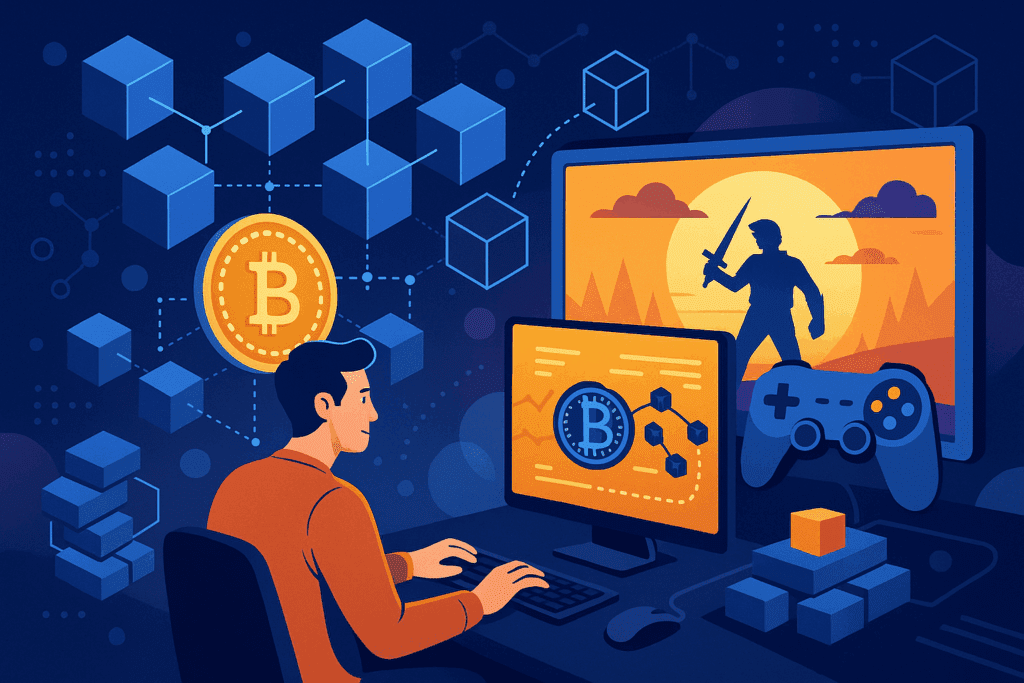
It’s quite simple: blockchain is a game changer because it allows players to finally own their digital assets. In traditional games, characters, skins, and items live behind centralized servers and vanish when a studio shuts down. Blockchain changes that by minting in-game assets as non-fungible tokens (NFTs) on decentralized ledgers. This means players can sell, trade, or gift items outside the original game, with no studio gatekeeper involved.
Ownership builds real value. For example, gamers worldwide spend thousands on virtual items during their lifetimes, yet most can’t resell or transfer them. Blockchain flips this narrative; instead of being sunk costs, digital goods become transferable and, in some cases, profitable assets.
Developers benefit too, with the ability to earn royalties on secondary market sales, creating a recurring revenue model that aligns their incentives with players.
This shift in asset control empowers players in unprecedented ways. This decentralization of asset control fosters greater attachment to items and characters, enriching the player’s relationship with the game.
Play-to-earn models and new monetization
One of blockchain’s most headline-grabbing innovations is the Play-to-Earn (P2E) model. Games like Axie Infinity made headlines for enabling players in the Philippines to generate income by breeding, battling, and trading fantasy creatures, a concept ingrained in people’s minds since Pokémon took over the world.
For some, this became a legitimate livelihood. The idea of playing a game and being rewarded with tokens or assets of real value turned the industry on its head.
Instead of spending money on in-game purchases that offer only entertainment, blockchain allows players to earn: which means in-game currencies and assets can be converted into cryptocurrency and then exchanged for fiat.
This model democratizes access to game-based income. It also gives rise to “guilds” and decentralized autonomous organizations (DAOs) where groups of players collaborate for profit.
We have discussed that in depth in another article regarding how blockchain games make money, listing methods like token staking, limited NFT drops, and marketplace transaction fees.
At the end of the day, developers must now approach economic design as a blend of game design and financial modeling. The health of a blockchain game economy depends on inflation control, token sink mechanisms, and consistent user incentives. Done right, P2E can create long-lasting, engaged communities. Done poorly, it can collapse under its own weight.
Decentralization, security, and trust
Perhaps blockchain’s greatest promise lies in decentralization.
You see, traditional games rely on servers managed by studios; if those servers go offline, player data, progress, and purchases may be lost. Blockchain games, however, anchor these elements in public ledgers, making them resistant to single points of failure.
This decentralized infrastructure builds trust: assets and transactions recorded on blockchain are immutable and transparent. Players no longer have to worry about a company changing the rules arbitrarily or removing features without warning. Game mechanics coded into smart contracts remain consistent and verifiable.
Security benefits follow naturally. Because players own wallets and keys, and because transactions require consensus to confirm, it’s harder for bad actors to exploit systems. Unlike centralized databases, where one breach can expose millions, decentralized ledgers distribute risk.
Games that embrace decentralization, like OPCraft, use smart contracts not just for economy management but for gameplay rules themselves.
This architecture creates what some are calling “autonomous worlds”, persistent game environments immune to interference. It’s a radical rethinking of game governance, placing long-term control in the hands of communities instead of corporations.
Check out the top 5 NFT games in 2025!
Challenges and considerations
Blockchain is a game changer, yes – but isn’t without obstacles. The technology is complex, and onboarding new users remains a major hurdle.
Wallet creation, key management, and gas fees are still foreign concepts to most gamers. Studios must invest in UX design to abstract these barriers and make participation seamless.
Scalability is another issue. Popular blockchains like Ethereum face high fees and slow transaction speeds, limiting their real-time game capabilities. Solutions like Layer-2 rollups, sidechains, and alternative blockchains (like Solana or Avalanche) offer improved performance, but require careful integration.
Environmental concerns also arise. Though many networks now use proof-of-stake to reduce energy consumption, blockchain’s carbon footprint is still scrutinized. Developers committed to sustainability must choose green-friendly chains and be transparent with their impact.
Regulatory uncertainty is perhaps the biggest wild card. With governments evaluating how to classify tokens, NFTs, and in-game currencies, developers must tread carefully. Legal compliance will be essential for long-term viability.
Finally, there’s the matter of perception. Blockchain gaming still battles reputational issues stemming from early scams, speculative bubbles, and poorly designed projects. Studios are working to change that by creating games that are, first and foremost, fun, with blockchain elements enhancing rather than overwhelming the experience.
So, is blockchain a game changer?
The answer is a resounding yes, for those willing to innovate smartly. From enabling player ownership and economic agency to decentralizing control and unlocking new revenue models, blockchain redefines how games are built and experienced.
That said, success requires careful planning. Tokenomics must be sustainable. Smart contracts must be secure. And, above all, games must remain enjoyable. Technology is the foundation, but design is the soul.
We here at Main Leaf like to think that we are one of the game development companies that are at the forefront of this evolution. With expertise in blockchain development, immersive design, and player-first experiences, we are uniquely positioned to help developers create the next wave of transformative games.
Contact us today to start building blockchain-powered games that players will love, trust, and return to for years to come!