Financial literacy is no longer confined to spreadsheets or lectures. In an era where 78% of students report stress over personal finance, innovative solutions like games for budgeting are reshaping how people engage with money management.
These interactive experiences blend education with entertainment, offering players a risk-free environment to experiment with financial decisions, confront real-world scenarios, and build lifelong skills.
This article explores the mechanics, benefits, and design principles behind budgeting games, while highlighting their potential to empower players and educators alike.
You may also like: How to find the perfect game app development company
The importance of games for budgeting

Traditional financial education often struggles to captivate audiences, particularly younger generations accustomed to dynamic digital experiences. Games for budgeting address this exact gap by transforming abstract concepts, like savings goals, credit scores, and unexpected expenses, into tangible, scenario-based challenges.
For example, PersonalFinanceLab’s Budgeting Game immerses students in a 12-month simulation where they balance part-time jobs, rent, taxes, and surprise costs like car repairs or medical bills.
By linking choices to consequences (e.g., overspending reduces credit scores), these games mirror real-life stakes without real-world repercussions.
Research underscores their effectiveness: gamified learning boosts retention rates by up to 90% compared to passive methods. This is partly due to emotional engagement, as players care about outcomes when they’ve invested time and effort into virtual personas.
A student managing a character’s budget in MoneySense’s The Budget Game, for example, experiences the stress of balancing bills and discretionary spending firsthand, fostering empathy and critical thinking.
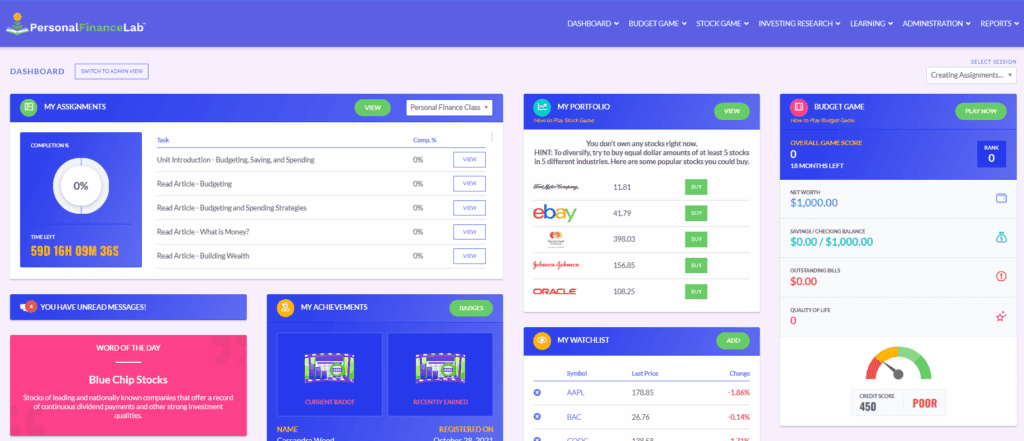
Key mechanics in successful games for budgeting
Effective games for budgeting share core design elements that balance education with engagement:
- Scenario-Based Learning: Games like NGPF’s Arcade introduce players to dilemmas such as surviving on gig economy income or navigating insurance claims. These scenarios teach prioritization, like choosing between paying a mortgage or covering emergency repairs, while emphasizing the value of contingency planning.
- Customizable Rulesets: Educators using PersonalFinanceLab’s platform can tailor variables like hourly wages, tax rates, and life events to reflect regional economic conditions. This adaptability ensures relevance across diverse audiences, from high school students to adults re-entering the workforce.
- Progress Tracking and Feedback: Immediate feedback loops, such as credit score updates or net worth rankings, help players correlate actions with outcomes. The Uber Game, for instance, shows how gig work instability impacts long-term financial stability, encouraging players to strategize rather than react impulsively.
- Integration with Curricula: Many platforms, including Practical Money Skills, pair games with lesson plans and assessments to reinforce classroom learning. This hybrid approach ensures theoretical concepts like compound interest or debt management are applied practically.
The technical backbone of games for budgeting
Behind every successful budgeting game lies a meticulously crafted technical foundation. Developers must balance intuitive design with complex systems that simulate financial realities, ensuring players learn without feeling overwhelmed.

Let’s dissect the frameworks and tools that power these experiences, along with real-world examples demonstrating their impact.
Dynamic Event Systems: Simulating Real-World Uncertainty
Budgeting games thrive on unpredictability. Advanced procedural algorithms generate randomized events, like medical emergencies or sudden income drops, to mimic the volatility of real-life finances.
Most of these games use weighted probability systems to adjust event frequency based on a player’s decisions. If a user overspends on leisure, the game increases the likelihood of a “car repair” event, teaching cause and effect organically.
Such systems require backend architectures capable of processing external data feeds while maintaining seamless gameplay.
Read also: GameFi Game Developer: Best Practices for Implementing Crypto Mechanics
Data Visualization: Translating Numbers into Insights
Clear UI/UX design is critical for transforming abstract financial data into digestible visuals. Games for budgeting usually employ color-coded pie charts and progress bars to illustrate spending categories.
Sophisticated tools like D3.js or Unity’s UI Toolkit enable developers to animate these elements, like with interactive sliders that let players adjust savings rates, with real-time updates to line graphs showing long-term wealth growth.
These visualizations not only simplify complex concepts but also encourage players to explore “what-if” scenarios without fear of failure.
Multiplatform Compatibility: Accessibility Across Devices
Modern budgeting games prioritize accessibility through cross-platform compatibility. Cloud-based engines like Unity and Unreal allow developers to deploy games across mobile, desktop, and even VR headsets.
Developers also leverage cloud saves and synchronization, enabling players to resume sessions across devices, ensuring continuity in long-term simulations. This requires robust backend services like Firebase or AWS to manage user data securely while maintaining low latency.
Balancing Realism and Engagement: The Developer’s Dilemma
One of the toughest challenges is creating systems that mirror real-world consequences without discouraging players.

We here at Main Leaf choose to address this through iterative prototyping. During pre-production phases, we test penalty mechanics (e.g., interest rates for overspending) to ensure they’re educational rather than punitive.
Ideally, you always want to strike a balance by allowing players to “reset” after failing at some task, emphasizing learning over punishment.
The future of games for budgeting
Emerging technologies promise to deepen immersion. Imagine VR simulations where players negotiate salaries in virtual offices or AR apps that overlay budget alerts onto real-world purchases.
New technologies are pushing budgeting games further: AI-driven chatbots analyze player decisions to offer personalized advice, while blockchain integrations enable tokenized rewards for hitting savings goals.
These innovations demand collaboration between financial experts and developers, combining economic modeling with gameplay loop optimization. By staying ahead of technical trends, studios ensure budgeting games remain both relevant and revolutionary.
However, the core challenge remains: designing games that are both educational and entertaining. Because, at the end of the day, budgeting games represent more than a teaching tool; they’re a gateway to financial confidence.

We here at Main Leaf have over a decade of expertise in Unity and Unreal Engine development, specializes in crafting immersive, purpose-driven games. Whether you’re an educator seeking a custom simulation or a publisher aiming to launch the next hit in financial literacy, our team transforms vision into reality.
Explore our blog for insights on game design trends, or contact us to discuss your project.